
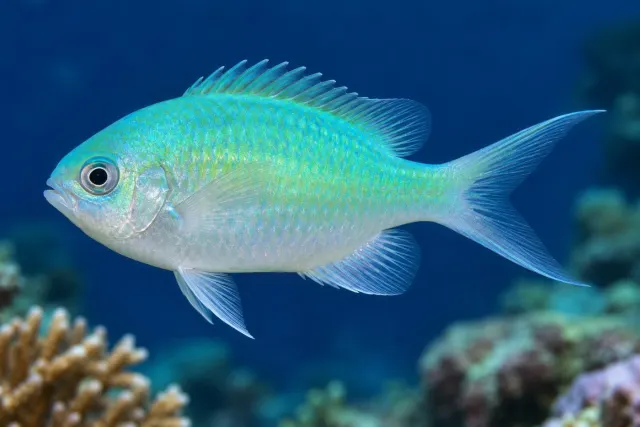
Chromis · Pomacentridae
Care levelIntermediate
Blue Green Chromis
Chromis viridis
A small blue-green, open-water reef fish with translucent fins. Chromis are social fish, but aquarium groups still need enough room, food and monitoring to manage chasing and competition.
Routine feeding is straightforward, but group welfare and uneven access to food require more attention than an easy-care label suggests.
Recommendation
Would you recommend this fish for a suitable saltwater aquarium?
30+ galRecommended tank
4 inchesAdult size
PeacefulTemperament
Generally compatibleCoral safety
+ Why you’ll love them
- Shimmering blue-green coloration.
- Active open-water swimmer.
- Generally compatible with reef invertebrates.
! Things to consider
- A 30-gallon individual baseline is not a group stocking allowance.
- Group hierarchy can cause chasing and losses.
- Needs frequent small meals and peaceful companions.
Tank and habitat
- Recommended volume
- 30 US gallons or larger; allow for stocking and layout.
- Full-grown size
- 4 inches (maximum adult size)
- Tank footprint and swimming space
- Provide open midwater swimming space and several separate rock shelters. Use substantially more space for a group than the individual baseline.
- Tank maturity
- Use a fully cycled, stable marine aquarium. Confirm filtration capacity before increasing the stock; elapsed months alone do not prove readiness. Suggested tank age is a planning guide, not proof of readiness. Complete cycling, stable water and the right food supply are essential.
- Habitat and equipment
- Arrange branching-style shelter or rock refuges below open water, with circulation, filtration and a secure lid.
Care and compatibility
- Temperament
- Peaceful
- Why this care level
- Routine feeding is straightforward, but group welfare and uneven access to food require more attention than an easy-care label suggests.
- Suitable tank mates and conflicts
- Choose peaceful community fish. Large predators and persistent territorial fish can intimidate or eat chromis.
- Alone, pair or group
- A social species: OATA recommends groups of at least five. This does not guarantee a stable aquarium group; monitor weaker fish and separate bullied individuals.
Corals and invertebrates
- Coral safety
-
Generally compatible
Generally compatible with corals. - Shrimp safety
-
Generally compatible
Generally compatible with ornamental shrimp; very small larvae may be eaten. - Snail safety
-
Generally compatible
Generally compatible with aquarium snails. - Clam safety
-
Generally compatible
Generally compatible with clams; normal individual monitoring still applies.
Food and feeding
- Diet
- Omnivore; varied marine foods
- Feeding plan
- Distribute small meals through the water column several times daily; verify every individual eats without leaving excess food.
- Prepared or live food
- Fine marine pellets or flakes, mysis, enriched brine shrimp and suitable mixed frozen foods.
Water conditions
- Temperature
- 72–78 °F (22–26 °C). Keep temperature stable and check the shared range for all tank inhabitants.
- Specific gravity
- Specific gravity 1.020–1.025 is the published fish-care range. A reef aquarium must also meet the needs of its invertebrates.
- pH
- pH 8.1–8.4. Monitor alkalinity and maintain stability rather than making abrupt corrections.
Long-term care
- Lifespan
- A dependable typical captive lifespan is not established by the references used here. Plan for a long-term commitment.
- Growth and future planning
- Adults reach about 4 inches (10 cm). Allow for the eventual size and feeding load of every group member.
Before you buy
- Is this fish right for your tank?
- Plan the group and filtration together. OATA recommends at least 200 litres (about 53 US gallons) for a group; Fish Match suggests 55 gallons or more as a starting point, adjusted for the complete stock.
- Buying checklist
- Observe feeding, breathing and swimming before purchase. Check body condition, fins and eyes; arrange quarantine and confirm the seller’s identification.
User comments (0)