
Basslets · Grammatidae
Care levelIntermediate
Brazilian Basslet
Gramma brasiliensis
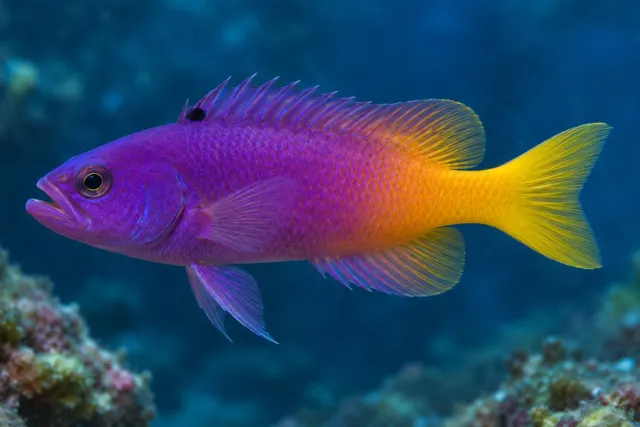
A Brazilian reef basslet with violet front coloration merging into a yellow-orange rear body. It resembles Royal Gramma but is a distinct species; identification and responsible sourcing matter more than trade names alone.
Its cave-oriented behavior and similarity to Royal Gramma call for careful identification, introduction and feeding checks.
Recommendation
Would you recommend this fish for a suitable saltwater aquarium?
30+ galRecommended tank
4 inchesAdult size
Semi-aggressive / territorialTemperament
Generally compatibleCoral safety
+ Why you’ll love them
- Violet and yellow-orange coloration.
- Natural cave and ledge behavior.
- Small-bodied plankton-feeding basslet for a carefully planned community.
! Things to consider
- Can compete for shelter with other grammas.
- Timid individuals need reliable food access.
- Verify species identity and responsible sourcing.
- The tank recommendation is editorial planning guidance.
Tank and habitat
- Recommended volume
- 30 US gallons or larger; allow for stocking and layout.
- Full-grown size
- 4 inches (maximum adult size)
- Tank footprint and swimming space
- Provide usable rockwork territory with several cave entrances and sight breaks, plus open space for feeding. Tank volume alone does not describe shelter availability.
- Tank maturity
- Use an established, fully cycled marine aquarium with stable filtration. There is no verified species-specific month threshold here; tank age alone does not prove readiness. Suggested tank age is a planning guide, not proof of readiness. Complete cycling, stable water and the right food supply are essential.
- Habitat and equipment
- Build small caves, ledges and shaded recesses with multiple escape routes. Secure the rockwork and cover the aquarium.
Care and compatibility
- Temperament
- Semi-aggressive / territorial
- Why this care level
- Its cave-oriented behavior and similarity to Royal Gramma call for careful identification, introduction and feeding checks.
- Suitable tank mates and conflicts
- Choose peaceful fish that will not swallow or persistently chase this basslet. Other grammas, basslets and similarly shaped cave dwellers need particular caution and a separation plan.
- Alone, pair or group
- Wild observations include solitary fish and small groups, but this does not establish a safe aquarium group size. One is the simpler plan; verify any claimed compatible pair.
Corals and invertebrates
- Coral safety
-
Generally compatible
Generally expected to leave coral tissue alone based on gramma feeding biology; observe the individual. This is not a guarantee for every reef community. - Shrimp safety
-
With caution
With caution: tiny shrimp or larvae may be prey. Species-specific safety for all ornamental shrimp is not established by these references. - Snail safety
-
Generally compatible
Generally expected to leave established snails alone; observe feeding and introductions rather than assuming universal safety. - Clam safety
-
Generally compatible
Generally expected to leave clam tissue alone. Continue checking for individual picking or disturbance.
Food and feeding
- Diet
- Carnivore; small marine meaty foods
- Feeding plan
- Offer suitably small marine meaty foods into the water near its shelter. Natural plankton picking does not replace a dependable aquarium diet.
- Prepared or live food
- Try fine mysis and suitable frozen plankton preparations. Ask the seller to demonstrate acceptance of prepared foods.
Water conditions
- Temperature
- 72–78 °F (22–26 °C) is general gramma aquarium planning guidance, not a tested species-specific tolerance. Confirm the individual’s requirements with its supplier.
- Specific gravity
- Specific gravity 1.020–1.025 is general marine fish planning guidance, not a measured species-specific limit. Also meet the needs of reef invertebrates.
- pH
- pH 8.1–8.4 is general marine aquarium guidance. Keep conditions stable; this is not a tested species-specific tolerance range.
Long-term care
- Lifespan
- The references used here do not establish a dependable typical captive lifespan. Plan for a long-term care commitment rather than an invented average.
- Growth and future planning
- FishBase records 6.6 cm standard length, excluding the tail. A Brazilian government guide gives 10 cm; the approximately 4-inch planning value is conservative and these measurements are not directly equivalent.
Before you buy
- Is this fish right for your tank?
- Fish Match uses 30 US gallons as conservative planning for one fish, rather than a tested species-specific minimum. Confirm identification, sourcing and a feeding specimen.
- Buying checklist
- Verify the scientific name, observe the fish eating and inspect breathing, fins, eyes and body condition. Plan quarantine, appropriate acclimation and a way to separate incompatible tank mates.
User comments (0)