
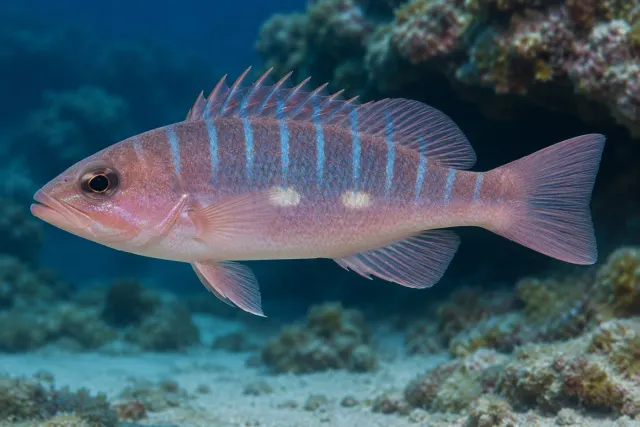
Basslets · Serranidae
Care levelBeginner
Chalk Bass
Serranus tortugarum
A small Caribbean sea bass with pale blue-gray to pinkish-brown coloring and narrow blue-gray bars along its upper body. Color intensity varies; these appearances belong to one species. Plan sheltered reef space and watch small shrimp around larger individuals.
Usually adaptable and willing to eat suitable foods. Shelter, compatible tank mates and protection of tiny shrimp still need planning.
Recommendation
Would you recommend this fish for a suitable saltwater aquarium?
30+ galRecommended tank
3.2 inchesAdult size
Semi-aggressive / territorialTemperament
Generally compatibleCoral safety
+ Why you’ll love them
- Subtle pink, lavender and blue-gray coloration.
- Generally leaves corals and sessile invertebrates alone.
- Usually accepts varied appropriately sized marine foods.
! Things to consider
- Larger individuals may prey on very small shrimp.
- Groups need additional territory and carefully planned introductions.
- Aggressive tank mates can prevent it from feeding or using shelter.
Tank and habitat
- Recommended volume
- 30 US gallons or larger; allow for stocking and layout.
- Full-grown size
- 3.2 inches (maximum adult size)
- Tank footprint and swimming space
- Provide sheltered bottom territory, several cave entrances and open feeding space. Increase usable room for a group; gallons alone do not describe available territories.
- Tank maturity
- Use a fully cycled aquarium with stable water and suitable shelter. There is no verified species-specific month threshold here; tank age alone does not prove readiness. Suggested tank age is a planning guide, not proof of readiness. Complete cycling, stable water and the right food supply are essential.
- Habitat and equipment
- Arrange secure live rock, shaded crevices and sandy or rubble-adjacent shelter. Maintain circulation and oxygenation, protect intakes and use a secure lid.
Care and compatibility
- Temperament
- Semi-aggressive / territorial
- Why this care level
- Usually adaptable and willing to eat suitable foods. Shelter, compatible tank mates and protection of tiny shrimp still need planning.
- Suitable tank mates and conflicts
- Many peaceful, appropriately sized marine community fish can work. Avoid persistent harassers, fish able to swallow it and tank mates small enough to be swallowed.
- Alone, pair or group
- A single individual is the simpler plan. Small groups can work with additional space and shelter; simultaneous introduction may help, but it does not guarantee compatibility. Be ready to separate chased fish.
Corals and invertebrates
- Coral safety
-
Generally compatible
Generally compatible with coral tissue and established sessile invertebrates. Observe the individual rather than assuming universal reef safety. - Shrimp safety
-
With caution
With caution: larger Chalk Bass may attack small ornamental shrimp, particularly tiny commensal shrimp. Do not assume every shrimp is safe because corals are left alone. - Snail safety
-
Generally compatible
Generally compatible with established aquarium snails. Tiny larvae and other small food organisms may be eaten. - Clam safety
-
Generally compatible
Generally compatible with clam tissue; continue checking for individual disturbance or picking.
Food and feeding
- Diet
- Carnivore; small marine meaty foods
- Feeding plan
- Offer varied mouth-sized marine meaty foods and check that every fish eats. Its natural plankton-feeding behavior does not replace a dependable aquarium diet.
- Prepared or live food
- Small mysis, enriched brine shrimp and suitable marine frozen foods; quality flakes or tiny pellets if accepted. Ask to see the actual specimen feed.
Water conditions
- Temperature
- 72–78 °F (22–26 °C) is the published aquarium reference range. Maintain stable conditions and consider all tank inhabitants.
- Specific gravity
- Specific gravity 1.020–1.025 is the published fish-care reference. Also meet the needs of any corals and other invertebrates.
- pH
- pH 8.1–8.4. Maintain stable conditions and monitor alkalinity instead of making abrupt corrections.
Long-term care
- Lifespan
- The references used here do not establish a dependable typical captive lifespan. Plan for long-term care rather than an invented average.
- Growth and future planning
- Aquarium references commonly list 3 inches; Smithsonian records up to 8 cm (about 3.2 inches). Plan for adult shelter and group territory rather than juvenile purchase size.
Before you buy
- Is this fish right for your tank?
- Start from the published 30-gallon individual reference and assess the complete stock. Confirm feeding and whether small ornamental shrimp are already present.
- Buying checklist
- Confirm Serranus tortugarum, observe feeding and inspect breathing, fins, eyes and body condition. Arrange quarantine and obtain the seller’s feeding routine.
User comments (0)