
Angelfish · Pomacanthidae
Care levelIntermediate
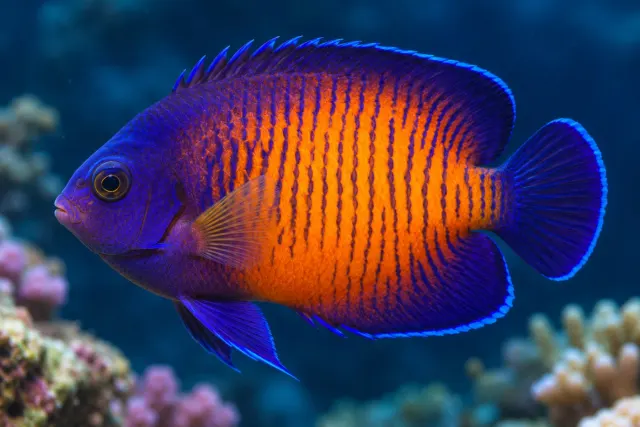
Coral Beauty Angelfish
Centropyge bispinosa
A blue-violet dwarf angelfish with orange-gold flanks and fine vertical markings. It needs established grazing rock and may nip coral tissue or clam mantles; captive breeding does not guarantee reef safety.
The main challenges are establishing reliable nutrition, managing territorial behavior and accepting an individual reef-picking risk.
Recommendation
Would you recommend this fish for a suitable saltwater aquarium?
70+ galRecommended tank
4.5 inchesAdult size
Semi-aggressive / territorialTemperament
With cautionCoral safety
+ Why you’ll love them
- Rich blue and orange coloration.
- Captive-bred individuals are available.
- Active rockwork grazer with an adult size suited to a planned community.
! Things to consider
- Corals and clam mantles may be nipped.
- Can defend a territory against other dwarf angels.
- Requires established rockwork and a varied diet.
Tank and habitat
- Recommended volume
- 70 US gallons or larger; allow for stocking and layout.
- Full-grown size
- 4.5 inches (maximum adult size)
- Tank footprint and swimming space
- Provide swimming room around complex rockwork, several caves and established surfaces for browsing.
- Tank maturity
-
6 months recommended
Use an established, fully cycled aquarium with stable conditions and mature grazing surfaces. Six months is planning guidance, not proof of readiness. Suggested tank age is a planning guide, not proof of readiness. Complete cycling, stable water and the right food supply are essential. - Habitat and equipment
- Secure porous rock, multiple sheltered routes, circulation and a lid. Leave access for observation and maintenance.
Care and compatibility
- Temperament
- Semi-aggressive / territorial
- Why this care level
- The main challenges are establishing reliable nutrition, managing territorial behavior and accepting an individual reef-picking risk.
- Suitable tank mates and conflicts
- Assess other dwarf angels and similarly shaped grazers cautiously. Avoid confining timid fish in the same defended rock territory.
- Alone, pair or group
- One dwarf angelfish is the simpler community plan. Unfamiliar adults may fight; do not assume two fish form a compatible pair.
Corals and invertebrates
- Coral safety
-
With caution
With caution: soft and stony corals may be picked at. Captive-bred origin does not remove this possibility. - Shrimp safety
-
Generally compatible
Generally compatible with established ornamental shrimp, but observe introductions and very small individuals. - Snail safety
-
Generally compatible
Generally compatible with snails; watch individual behavior. - Clam safety
-
With caution
With caution: exposed clam mantles can attract repeated picking.
Food and feeding
- Diet
- Omnivore; varied marine foods
- Feeding plan
- Combine grazing opportunities with marine algae and varied appropriate angelfish foods; monitor weight and feeding access.
- Prepared or live food
- Suitable angelfish preparations, algae-containing pellets and finely sized marine frozen foods. Confirm the individual accepts your intended diet.
Water conditions
- Temperature
- 72–78 °F (22–26 °C). Keep temperature stable and check the shared range for all tank inhabitants.
- Specific gravity
- Specific gravity 1.020–1.025 is the published fish-care range. A reef aquarium must also meet the needs of its invertebrates.
- pH
- pH 8.1–8.4. Monitor alkalinity and maintain stability rather than making abrupt corrections.
Long-term care
- Lifespan
- A dependable typical captive lifespan is not established by the references used here. Plan for a long-term commitment.
- Growth and future planning
- Aquarium guides often list about 4 inches; FishBase lists up to 11.5 cm (about 4.5 inches) total length. Plan adult territory as well as body size.
Before you buy
- Is this fish right for your tank?
- Plan at least 70 US gallons and confirm feeding. In a reef, have a practical plan for removing an individual that persistently picks at livestock.
- Buying checklist
- Observe feeding, breathing and swimming before purchase. Check body condition, fins and eyes; arrange quarantine and confirm the seller’s identification.
User comments (0)