
Gobies · Gobiidae
Care levelIntermediate
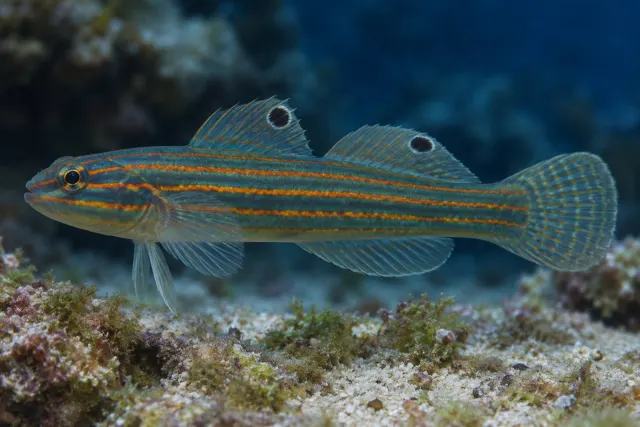
Court Jester Goby
Koumansetta rainfordi
A slender green-blue goby crossed by fine orange stripes. Captive-bred specimens trained onto prepared foods are a useful option; wild fish may be difficult to feed and require an established grazing environment.
Foraging behavior can hide poor nutrition. Verify prepared-food acceptance and maintain body condition, especially with wild-caught fish.
Recommendation
Would you recommend this fish for a suitable saltwater aquarium?
10+ galRecommended tank
3 inchesAdult size
Peaceful; territorial with similar gobiesTemperament
Generally compatibleCoral safety
+ Why you’ll love them
- Distinctive coloration and behavior.
- Picks and grazes around established rock and sand.
- Generally peaceful toward appropriately chosen dissimilar fish.
! Things to consider
- May be difficult to feed; verify acceptance rather than assuming grazing is enough.
- Similar gobies can dispute shelter or territory.
- Needs secure cover and a suitable adult habitat.
Tank and habitat
- Recommended volume
- 10 US gallons or larger; allow for stocking and layout.
- Full-grown size
- 3 inches (maximum adult size)
- Tank footprint and swimming space
- Arrange sheltered resting places and usable feeding space with several escape routes. Increase space for territorial neighbors; the listed gallons are an individual baseline, not full-group capacity.
- Tank maturity
-
6 months recommended
Use established sand and grazing surfaces with stable filtration. Six months is editorial planning guidance, not a verified readiness threshold; prove the feeding routine works. Suggested tank age is a planning guide, not proof of readiness. Complete cycling, stable water and the right food supply are essential. - Habitat and equipment
- Provide established rock, low algae-covered grazing areas, fine sand, quiet retreats and protected intakes. Fit a secure lid.
Care and compatibility
- Temperament
- Peaceful; territorial with similar gobies
- Why this care level
- Foraging behavior can hide poor nutrition. Verify prepared-food acceptance and maintain body condition, especially with wild-caught fish.
- Suitable tank mates and conflicts
- Choose peaceful fish that cannot swallow this goby. Avoid persistent harassers, predatory basses and aggressive bottom dwellers; ensure every fish can reach food.
- Alone, pair or group
- One is the simpler plan. Similar gobies may compete for grazing and shelter; a larger aquarium and simultaneous introduction do not guarantee a stable group.
Corals and invertebrates
- Coral safety
-
Generally compatible
Generally leaves coral tissue alone; continue observing the individual and its resting behavior. - Shrimp safety
-
With caution
Generally compatible with established ornamental shrimp, but tiny shrimp and larvae may be eaten. Predatory crustaceans can threaten the goby. - Snail safety
-
Generally compatible
Generally compatible with established snails; tiny larvae and small food organisms may be eaten. - Clam safety
-
Generally compatible
Generally leaves clam tissue alone; monitor the individual and keep normal feeding needs met.
Food and feeding
- Diet
- Omnivore; grazing plus varied prepared foods
- Feeding plan
- Provide a varied omnivore diet with fine marine meaty foods and suitable algae-containing preparations. Grazing is a supplement; verify every individual actually eats.
- Prepared or live food
- Offer fine frozen marine foods and suitable small prepared foods. Captive-bred Court Jesters may already be trained to pellets; acceptance should be checked for the actual fish.
Water conditions
- Temperature
- 72–78 °F (22–26 °C) is the marine aquarium reference range used here. Maintain stable conditions and consider all inhabitants.
- Specific gravity
- Specific gravity 1.020–1.025 is a common fish-care reference range. Corals and other invertebrates may require a narrower target.
- pH
- pH 8.1–8.4. Maintain stability and monitor alkalinity instead of making abrupt corrections.
Long-term care
- Lifespan
- The references used here do not establish a dependable typical captive lifespan. Plan for long-term care without assuming an invented average.
- Growth and future planning
- Published aquarium guidance lists up to about 3 inches. Plan for adult shelter and feeding needs rather than the juvenile’s purchase size.
Before you buy
- Is this fish right for your tank?
- Ask for a captive-bred individual and observe its actual food acceptance. Natural grazing is not proof of adequate nutrition; watch body condition.
- Buying checklist
- Check the scientific name, observe feeding and inspect the eyes, fins, breathing and body condition. Arrange quarantine and confirm the seller’s feeding and acclimation routine.
User comments (0)