
Basslets · Serranidae
Care levelIntermediate
Harlequin Bass
Serranus tigrinus
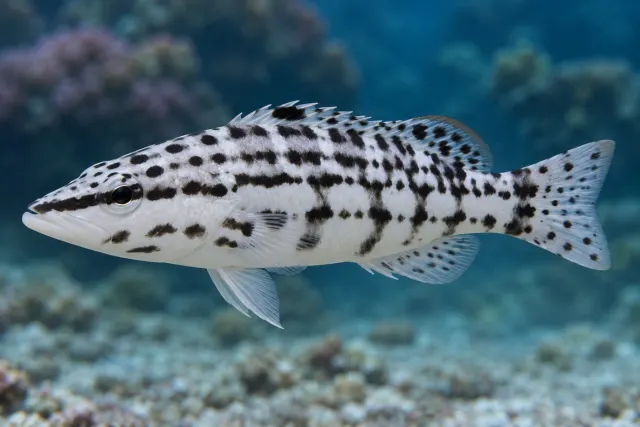
A Caribbean sea bass with dark broken bars and spots over a white-to-cream body. Yellow on the lower body can be subtle or more noticeable. Its main community risk is predation: small fish and crustaceans can become food even when it appears calm.
Prepared feeding is often manageable; predation, adult planning and territory disputes need careful assessment.
Recommendation
Would you recommend this fish for a suitable saltwater aquarium?
75+ galRecommended tank
5 inchesAdult size
Semi-aggressive / territorialTemperament
Generally compatibleCoral safety
+ Why you’ll love them
- Contrasting dark bars and spots on a white-to-cream body.
- Generally leaves coral tissue alone.
- Interesting rock-associated behavior in a suitable predator-aware community.
! Things to consider
- Small fish and ornamental shrimp may be eaten.
- May dispute shelter with similar basses or bottom dwellers.
- Published maximum size figures differ substantially; plan conservatively.
Tank and habitat
- Recommended volume
- 75 US gallons or larger; allow for stocking and layout.
- Full-grown size
- 5 inches (maximum adult size)
- Tank footprint and swimming space
- Provide a generous bottom footprint with several caves, sight breaks and room around each shelter.
- Tank maturity
- Use a fully cycled, stable marine aquarium. Confirm filtration capacity before increasing the stock; elapsed months alone do not prove readiness. Suggested tank age is a planning guide, not proof of readiness. Complete cycling, stable water and the right food supply are essential.
- Habitat and equipment
- Secure rock shelters, open feeding areas, capable filtration and a covered aquarium. Plan access for separating incompatible fish.
Care and compatibility
- Temperament
- Semi-aggressive / territorial
- Why this care level
- Prepared feeding is often manageable; predation, adult planning and territory disputes need careful assessment.
- Suitable tank mates and conflicts
- Small fish, including firefish, small chromis and juvenile cardinalfish, can be prey. Assess adult mouth size and body shape, not temperament alone.
- Alone, pair or group
- Keep one unless an established compatible pair has been verified. Monitor other basses and fish using the same bottom shelters.
Corals and invertebrates
- Coral safety
-
Generally compatible
Generally compatible with coral tissue. Reef safety does not mean safety for small fish or crustaceans. - Shrimp safety
-
Not compatible
Not compatible with vulnerable ornamental shrimp: predation is a central risk. - Snail safety
-
With caution
With caution: the references do not establish safety for every snail or small mobile invertebrate; monitor rather than assuming protection. - Clam safety
-
Generally compatible
Generally compatible with clam tissue; continue observing individual behavior.
Food and feeding
- Diet
- Carnivore; suitable marine meaty foods
- Feeding plan
- Provide varied appropriately sized marine meaty foods. Feeding well does not make small tank mates safe.
- Prepared or live food
- Chopped marine seafood and suitable frozen carnivore preparations; check acceptance of prepared foods before purchase.
Water conditions
- Temperature
- 72–78 °F (22–26 °C). Keep temperature stable and check the shared range for all tank inhabitants.
- Specific gravity
- Specific gravity 1.020–1.025 is the published fish-care range. A reef aquarium must also meet the needs of its invertebrates.
- pH
- pH 8.1–8.4. Monitor alkalinity and maintain stability rather than making abrupt corrections.
Long-term care
- Lifespan
- A dependable typical captive lifespan is not established by the references used here. Plan for a long-term commitment.
- Growth and future planning
- Published size records conflict: Smithsonian lists 12.3 cm, while FishBase reports 29 cm fork length and a retail guide lists 11.5 inches. The 11.5-inch planning value is conservative, not a typical captive-size claim.
Before you buy
- Is this fish right for your tank?
- Choose tank mates too large to swallow and plan at least 75 US gallons. This is not a safe addition to a small-fish or ornamental-shrimp collection.
- Buying checklist
- Observe feeding, breathing and swimming before purchase. Check body condition, fins and eyes; arrange quarantine and confirm the seller’s identification.
User comments (0)