
Gobies · Gobiidae
Care levelIntermediate
Hi-Fin Red-Banded Goby
Stonogobiops nematodes
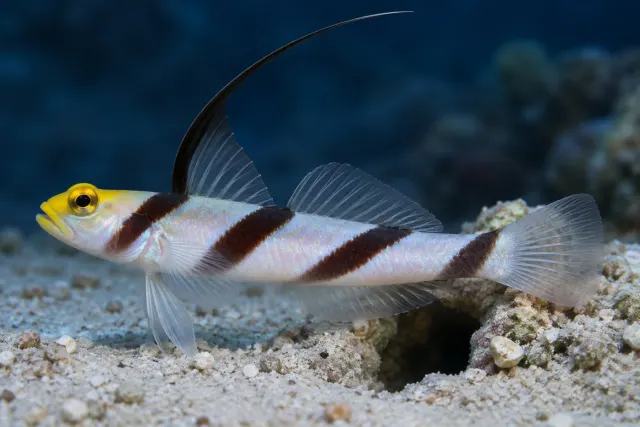
A small shrimp goby with a pale body, dark diagonal bands, yellow face and high black dorsal ray. Despite its trade name, the diagnostic body bands are usually dark brown to black.
Burrow shelter, stable rock support and food delivery to a shy bottom feeder require planning.
Recommendation
Would you recommend this fish for a suitable saltwater aquarium?
10+ galRecommended tank
2 inchesAdult size
Peaceful; territorial with similar gobiesTemperament
Generally compatibleCoral safety
+ Why you’ll love them
- Distinctive coloration and behavior.
- May share a burrow with a compatible pistol shrimp.
- Generally peaceful toward appropriately chosen dissimilar fish.
! Things to consider
- Small or shy fish can lose access to food or become prey.
- Similar gobies can dispute shelter or territory.
- Needs secure cover and a suitable adult habitat.
Tank and habitat
- Recommended volume
- 10 US gallons or larger; allow for stocking and layout.
- Full-grown size
- 2 inches (maximum adult size)
- Tank footprint and swimming space
- Provide a sand-covered bottom with separate burrow territories, stable overhead shelter and retreat routes. Burrow space matters more than extra height.
- Tank maturity
- Use a fully cycled aquarium with stable filtration and a dependable feeding plan. Tank age alone does not demonstrate readiness. Suggested tank age is a planning guide, not proof of readiness. Complete cycling, stable water and the right food supply are essential.
- Habitat and equipment
- Use suitable fine sand and limited rubble for shelter. Support heavy rock on a stable base rather than loose excavatable sand, protect intakes and fit a secure lid.
Care and compatibility
- Temperament
- Peaceful; territorial with similar gobies
- Why this care level
- Burrow shelter, stable rock support and food delivery to a shy bottom feeder require planning.
- Suitable tank mates and conflicts
- Choose peaceful fish that cannot swallow this goby. Avoid persistent harassers, predatory basses and aggressive bottom dwellers; ensure every fish can reach food.
- Alone, pair or group
- Keep singly or as a verified compatible pair. A suitable pistol shrimp may share a burrow, but not all shrimp species or individual combinations are appropriate. A shrimp partner is not a substitute for fish feeding.
Corals and invertebrates
- Coral safety
-
Generally compatible
Generally leaves coral tissue alone; continue observing the individual and its resting behavior. - Shrimp safety
-
With caution
May associate with a compatible pistol shrimp. Identify both animals before pairing; ornamental shrimp compatibility and shrimp-to-fish predation still need assessment. - Snail safety
-
Generally compatible
Generally compatible with established snails; tiny larvae and small food organisms may be eaten. - Clam safety
-
Generally compatible
Generally leaves clam tissue alone; monitor the individual and keep normal feeding needs met.
Food and feeding
- Diet
- Carnivore; suitable small marine meaty foods
- Feeding plan
- Offer suitable marine meaty food at least twice daily near the burrow. Confirm the goby takes food rather than losing it to faster fish.
- Prepared or live food
- Fine mysis, enriched brine shrimp and suitable marine preparations; use small pellets if the individual demonstrably accepts them.
Water conditions
- Temperature
- 72–78 °F (22–26 °C) is the marine aquarium reference range used here. Maintain stable conditions and consider all inhabitants.
- Specific gravity
- Specific gravity 1.020–1.025 is a common fish-care reference range. Corals and other invertebrates may require a narrower target.
- pH
- pH 8.1–8.4. Maintain stability and monitor alkalinity instead of making abrupt corrections.
Long-term care
- Lifespan
- The references used here do not establish a dependable typical captive lifespan. Plan for long-term care without assuming an invented average.
- Growth and future planning
- Published aquarium guidance lists up to about 2 inches. Plan for adult shelter and feeding needs rather than the juvenile’s purchase size.
Before you buy
- Is this fish right for your tank?
- Confirm feeding and provide a peaceful sandy territory. Small size and a shy nature make competition at feeding time important.
- Buying checklist
- Check the scientific name, observe feeding and inspect the eyes, fins, breathing and body condition. Arrange quarantine and confirm the seller’s feeding and acclimation routine.
User comments (0)