
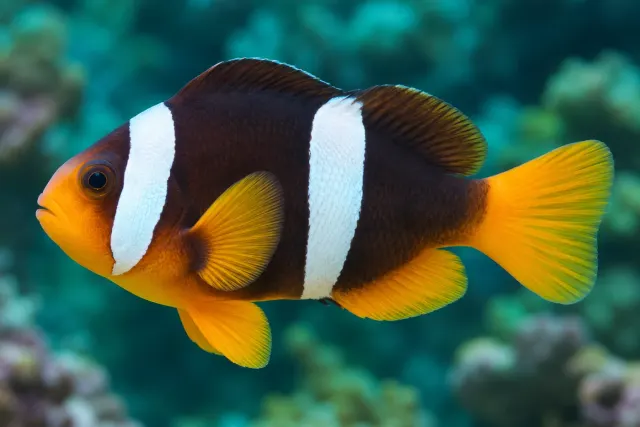
Clownfish · Pomacentridae
Care levelExpert
Madagascar Clownfish
Amphiprion latifasciatus
Madagascar Clownfish has black-brown body, two broad white bands and yellow-orange face belly and tail. This anemonefish is associated with Madagascar and Comoros. A regional Madagascar-area species with broad bands. Do not substitute generic clownfish advice for advice from a specialist familiar with the individual.
Uncommon species, uncertain captive requirements or subtropical conditions call for experienced, species-specific planning.
Recommendation
Would you recommend this fish for a suitable saltwater aquarium?
55+ galRecommended tank
5.1 inchesAdult size
Semi-aggressive / territorialTemperament
Generally compatibleCoral safety
+ Why you’ll love them
- Distinctive Madagascar appearance.
- Can be kept in a thoughtfully planned marine or reef aquarium.
- Omnivorous feeding allows a varied marine-food menu.
- Offers an opportunity to learn about regional anemonefish diversity; availability is limited.
! Things to consider
- A regional Madagascar-area species with broad bands. Do not substitute generic clownfish advice for advice from a specialist familiar with the individual.
- Avoid mixing clownfish species or unplanned adult groups.
- An anemone has separate lighting, maturity and equipment needs.
- Quarantine new arrivals and confirm they eat before purchase.
- Species-specific captive data are limited; specialist planning is recommended.
Tank and habitat
- Recommended volume
- 55 US gallons or larger; allow for stocking and layout.
- Full-grown size
- 5.1 inches (maximum adult size)
- Tank footprint and swimming space
- Use a rectangular layout with separate sheltered territories and open feeding space. The 55-gallon figure is a conservative planning recommendation, not a stocking guarantee.
- Tank maturity
-
6 months recommended
Suggested minimum age: 6 months. A completed nitrogen cycle and consistently stable water are essential; calendar age alone does not establish readiness. Suggested tank age is a planning guide, not proof of readiness. Complete cycling, stable water and the right food supply are essential. - Habitat and equipment
- Stable filtration, sheltered rockwork, open feeding areas and a fitted lid. An anemone is not required for routine captive care; research any host separately.
Care and compatibility
- Temperament
- Semi-aggressive / territorial
- Why this care level
- Uncommon species, uncertain captive requirements or subtropical conditions call for experienced, species-specific planning.
- Suitable tank mates and conflicts
- Appropriately sized community fish; avoid predators, persistent bullies and competing clownfish. A calm community is especially important for shy individuals.
- Alone, pair or group
- Keep one fish or one established compatible pair. Do not add an unfamiliar adult or assume a group will remain compatible.
Corals and invertebrates
- Coral safety
-
Generally compatible
Generally compatible. Repeated hosting contact may irritate some corals; monitor the chosen territory. - Shrimp safety
-
Generally compatible
Generally compatible with established ornamental shrimp; tiny shrimp and larvae may be eaten. - Snail safety
-
Generally compatible
Generally compatible with ordinary aquarium snails; observe the individual fish. - Clam safety
-
Generally compatible
Generally compatible with clams. Monitor for persistent irritation or unusual picking.
Food and feeding
- Diet
- Omnivore; varied marine foods and suitable algae-containing preparations
- Feeding plan
- Offer appropriately sized marine pellets or flakes plus varied frozen marine foods in small portions, usually twice daily. Include suitable algae-containing preparations and check every fish feeds.
- Prepared or live food
- Ask the seller to demonstrate feeding. Captive-bred individuals often accept prepared food; newly imported fish may need a slower transition.
Water conditions
- Temperature
- Maintain a stable tropical marine temperature, commonly around 24–26 C (75–79 F); confirm the supplier conditions, particularly for regional or rare species.
- Specific gravity
- Maintain stable marine salinity, typically about 1.023–1.026 specific gravity for a reef aquarium; match livestock needs and acclimate gradually.
- pH
- Maintain stable marine pH, generally 8.1–8.4, with appropriate alkalinity and gas exchange.
Long-term care
- Lifespan
- A reliable typical captive lifespan for this species or named variety is not established in the cited references. Plan for a long-term commitment and ongoing care.
- Growth and future planning
- Reported species length is approximately 13 cm (5.1 inches); females are often larger than males. Do not select an aquarium based only on juvenile sale size.
Before you buy
- Is this fish right for your tank?
- Plan for an adult in at least 55 US gallons as a conservative Fish Match starting recommendation, with additional space for pairs and tank mates. A regional Madagascar-area species with broad bands. Do not substitute generic clownfish advice for advice from a specialist familiar with the individual.
- Buying checklist
- Confirm species, captive-bred or collection origin, legal sourcing, feeding response and body condition. For a pair, ask whether the fish are already compatible. Request species-specific advice for uncommon fish.
User comments (0)