
Clownfish · Pomacentridae
Care levelBeginner
Ocellaris Clownfish
Amphiprion ocellaris
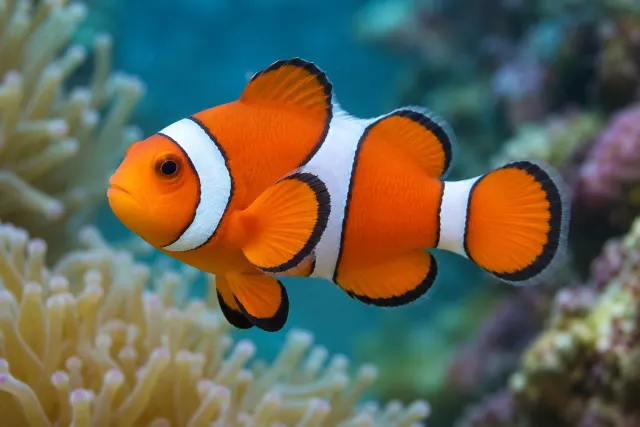
A familiar reef favorite with a bright orange body and three white bands. Captive-bred Ocellaris Clownfish are a popular choice for established saltwater aquariums. They do not need an anemone to thrive.
Captive-bred fish commonly accept prepared food, but a breeding pair can defend its territory.
Recommendation
Would you recommend this fish for a suitable saltwater aquarium?
30+ galRecommended tank
4 inchesAdult size
Semi-aggressive / territorialTemperament
Generally compatibleCoral safety
+ Why you’ll love them
- Captive-bred fish are widely available.
- Small adult size suits a thoughtfully planned reef.
- Usually accepts a varied diet of prepared marine foods.
- Reef compatible and full of personality.
! Things to consider
- Can defend a chosen territory, especially when breeding.
- Avoid mixing different clownfish species in a small aquarium.
- A bonded pair needs space and suitable tank mates.
- Anemones have separate care and lighting requirements.
Tank and habitat
- Recommended volume
- 30 US gallons or larger; allow for stocking and layout.
- Full-grown size
- 4 inches (maximum adult size)
- Tank footprint and swimming space
- Allow room for a defended territory as well as other fish; volume alone does not define a good layout.
- Tank maturity
-
1 month recommended
A fully cycled, stable aquarium; an anemone has separate, more demanding requirements. Suggested tank age is a planning guide, not proof of readiness. Complete cycling, stable water and the right food supply are essential. - Habitat and equipment
- Provide sheltered rockwork, filtration and a covered tank; no special anemone lighting is needed for the fish.
Care and compatibility
- Temperament
- Semi-aggressive / territorial
- Why this care level
- Captive-bred fish commonly accept prepared food, but a breeding pair can defend its territory.
- Suitable tank mates and conflicts
- Calm community fish of suitable size; avoid larger bullies and mixing clownfish species in a small tank.
- Alone, pair or group
- One fish or an established compatible pair; unfamiliar adults can fight.
Corals and invertebrates
- Coral safety
-
Generally compatible
Generally coral safe, although repeated hosting contact can irritate some corals. - Shrimp safety
-
Generally compatible
Generally compatible with established ornamental shrimp; very small animals need caution. - Snail safety
-
Generally compatible
Generally compatible. - Clam safety
-
Generally compatible
Generally compatible; observe individual behavior.
Food and feeding
- Diet
- Omnivore; varied marine foods
- Feeding plan
- Offer small portions of varied marine foods daily, split into more than one feeding when appropriate.
- Prepared or live food
- Captive-bred fish commonly take appropriately sized pellets, flakes and frozen foods.
Water conditions
- Temperature
- 72-78 F (22-26 C); keep temperature stable.
- Specific gravity
- 1.020-1.025 specific gravity in the species care guidance; also meet your corals' needs.
- pH
- 8.1-8.4, with stable daily conditions.
Long-term care
- Lifespan
- Ocellaris have documented captive records exceeding 20 years; this is a longevity record, not a typical lifespan guarantee.
- Growth and future planning
- Buy for adult size and paired territorial behavior, not the tiny size of a juvenile.
Before you buy
- Is this fish right for your tank?
- Choose captive-bred fish and plan for a single fish or compatible pair. An anemone is optional.
- Buying checklist
- Ask to see it eat; check its condition and plan quarantine.
User comments (0)