
Cardinalfish · Apogonidae
Care levelBeginner
Pajama Cardinalfish
Sphaeramia nematoptera
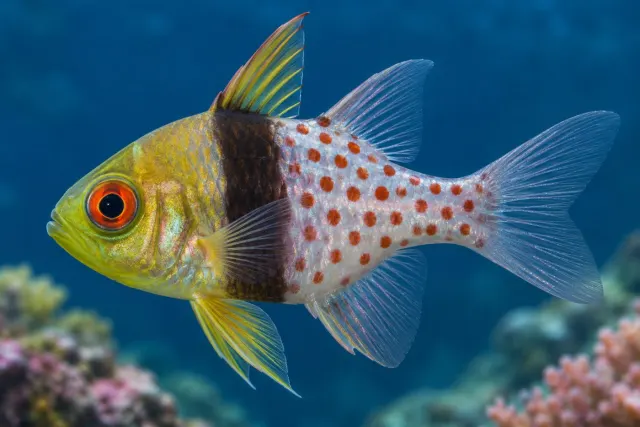
A peaceful, slow-moving cardinalfish with orange eyes, a dark midbody band and spotted rear flanks. Provide sheltered resting areas and make sure faster fish do not take all its food.
Generally adaptable in a stable aquarium when peaceful tank mates and reliable feeding access are provided.
Recommendation
Would you recommend this fish for a suitable saltwater aquarium?
30+ galRecommended tank
3.5 inchesAdult size
PeacefulTemperament
Generally compatibleCoral safety
+ Why you’ll love them
- Unusual spots and contrasting body pattern.
- Generally reef compatible.
- Suitable for a thoughtfully stocked peaceful community.
! Things to consider
- May lose food to fast or assertive tank mates.
- A group needs more room than an individual minimum.
- Large predatory fish are unsuitable companions.
Tank and habitat
- Recommended volume
- 30 US gallons or larger; allow for stocking and layout.
- Full-grown size
- 3.5 inches (maximum adult size)
- Tank footprint and swimming space
- Provide sheltered resting sites and open feeding space. Increase usable space for a group and the rest of the community.
- Tank maturity
- Use a fully cycled, stable marine aquarium. Confirm filtration capacity before increasing the stock; elapsed months alone do not prove readiness. Suggested tank age is a planning guide, not proof of readiness. Complete cycling, stable water and the right food supply are essential.
- Habitat and equipment
- Create several shaded rock shelters with gentle resting areas away from the strongest pump discharge. Use a secure lid.
Care and compatibility
- Temperament
- Peaceful
- Why this care level
- Generally adaptable in a stable aquarium when peaceful tank mates and reliable feeding access are provided.
- Suitable tank mates and conflicts
- Favor peaceful fish of compatible size. Avoid predatory basses and fish that repeatedly chase slow feeders.
- Alone, pair or group
- May be kept in a suitably housed small group. Monitor hierarchy and feeding; do not assume all introduced individuals will be accepted.
Corals and invertebrates
- Coral safety
-
Generally compatible
Generally compatible with corals. - Shrimp safety
-
Generally compatible
Usually compatible with established ornamental shrimp; tiny shrimp and larvae may become food. - Snail safety
-
Generally compatible
Generally compatible with snails. - Clam safety
-
Generally compatible
Generally compatible with clams.
Food and feeding
- Diet
- Carnivore; suitable marine meaty foods
- Feeding plan
- Offer small portions of suitable marine meaty foods and watch this slower feeder take its share.
- Prepared or live food
- Finely sized mysis and other marine frozen foods; small pellets or flakes if the individual accepts them.
Water conditions
- Temperature
- 72–78 °F (22–26 °C). Keep temperature stable and check the shared range for all tank inhabitants.
- Specific gravity
- Specific gravity 1.020–1.025 is the published fish-care range. A reef aquarium must also meet the needs of its invertebrates.
- pH
- pH 8.1–8.4. Monitor alkalinity and maintain stability rather than making abrupt corrections.
Long-term care
- Lifespan
- A dependable typical captive lifespan is not established by the references used here. Plan for a long-term commitment.
- Growth and future planning
- Allow for about 3.5 inches at adulthood and the combined feeding load of a group.
Before you buy
- Is this fish right for your tank?
- Plan a peaceful community and feeding access for every cardinalfish. The 30-gallon recommendation is a starting point, not permission for an unlimited group.
- Buying checklist
- Observe feeding, breathing and swimming before purchase. Check body condition, fins and eyes; arrange quarantine and confirm the seller’s identification.
User comments (0)