
Dottybacks · Pseudochromidae
Care levelBeginner
Yellow-Breasted Dottyback
Pseudochromis coccinicauda
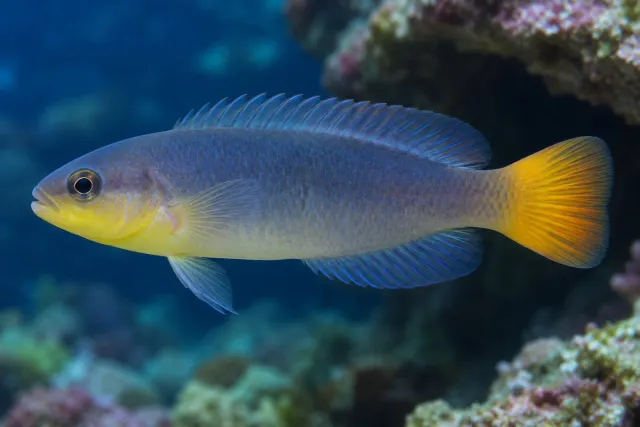
Adult female or juvenile blue-gray body with pale yellow lower face and throat, yellow-orange caudal fin, subtly blue translucent dorsal and anal fins. A cave-dwelling carnivore that needs shelter and thoughtful introductions.
A sheltered aquarium and appropriate foods can suit this fish, but territorial behavior still needs observation and a separation plan.
Recommendation
Would you recommend this fish for a suitable saltwater aquarium?
30+ galRecommended tank
3 inchesAdult size
Semi-aggressive / territorialTemperament
Generally compatibleCoral safety
+ Why you’ll love them
- Distinctive Yellow-Breasted appearance.
- Rockwork and sheltered crevices provide natural cover.
- Suitable marine meaty foods can support a varied captive diet.
! Things to consider
- May defend caves and chase smaller fish.
- Small crustaceans may be eaten; ornamental shrimp require caution.
- Other dottybacks may provoke disputes; gallons alone do not create separate territories.
Tank and habitat
- Recommended volume
- 30 US gallons or larger; allow for stocking and layout.
- Full-grown size
- 3 inches (maximum adult size)
- Tank footprint and swimming space
- Use a tank with substantial horizontal rockwork, multiple shaded caves and broken sight lines. Distribute shelters rather than creating one contested cave. Group stocking may need much more room than the individual reference.
- Tank maturity
- Use a fully cycled, stable marine aquarium with established shelter and filtration. No dependable species-specific month threshold is established here; age alone does not prove readiness. Suggested tank age is a planning guide, not proof of readiness. Complete cycling, stable water and the right food supply are essential.
- Habitat and equipment
- Secure porous rockwork, shaded crevices, unobstructed feeding access and suitable flow. Cover escape openings and protect intakes. Retain several escape routes for less assertive inhabitants.
Care and compatibility
- Temperament
- Semi-aggressive / territorial
- Why this care level
- A sheltered aquarium and appropriate foods can suit this fish, but territorial behavior still needs observation and a separation plan.
- Suitable tank mates and conflicts
- Semi-aggressive / territorial: may chase small or timid gobies, firefish, basslets and similar crevice-dwelling fish. Use compatible, appropriately sized tank mates and separated refuges.
- Alone, pair or group
- One individual is the simpler plan. Do not assume a random pair, a large group or different dottyback species will coexist. Specialist breeding arrangements do not establish safety for arbitrary adults. Use a confirmed pair only with suitable expert guidance and separate if necessary.
Corals and invertebrates
- Coral safety
-
Generally compatible
Generally compatible with coral tissue. Coral safety does not mean compatibility with all fish or invertebrates; monitor the individual. - Shrimp safety
-
With caution
Small shrimp and other crustaceans may be eaten. Adult ornamental shrimp still require caution, especially when molting. Do not rely on this fish for guaranteed pest control. - Snail safety
-
Generally compatible
Established shelled aquarium snails are generally compatible; tiny invertebrates and larvae may be eaten. - Clam safety
-
Generally compatible
Generally compatible with clam tissue. Observe individual behavior and ensure that clam requirements are met independently.
Food and feeding
- Diet
- Carnivore; varied marine meaty foods
- Feeding plan
- Offer appropriately sized, varied marine meaty meals in small portions multiple times daily. Make sure food reaches the rockwork without leaving excessive waste. Confirm actual intake and body condition.
- Prepared or live food
- Mysis, enriched brine shrimp and finely chopped suitable marine seafood; quality carnivore pellets or flakes if the individual accepts them. Obtain the seller’s established feeding routine.
Water conditions
- Temperature
- 72–78 °F (22–26 °C). Published supplier aquarium reference range. Maintain stability and consider every inhabitant.
- Specific gravity
- Specific gravity 1.020–1.025 is the tropical fish-care reference used here. Also meet the needs of corals and other invertebrates; avoid abrupt changes.
- pH
- pH 8.1–8.4. Keep conditions stable and monitor alkalinity rather than making abrupt corrections.
Long-term care
- Lifespan
- The sources used here do not establish a dependable typical captive lifespan for this entry. Plan for long-term care rather than an invented numerical average.
- Growth and future planning
- The supplier gives an approximate adult reference of 3 inches. Sex, age and locality may affect appearance; plan for adult space rather than purchase size.
Before you buy
- Is this fish right for your tank?
- The supplier lists 30 US gallons or larger as an individual aquarium reference. Semi-aggressive / territorial: may chase small or timid gobies, firefish, basslets and similar crevice-dwelling fish. Use compatible, appropriately sized tank mates and separated refuges.
- Buying checklist
- Confirm Pseudochromis coccinicauda, observe feeding, inspect fins and breathing, and obtain origin and feeding details. Males and females may look markedly different. The illustration depicts a female or juvenile appearance; verify the scientific identity with the seller. Plan quarantine before introduction.
User comments (0)