
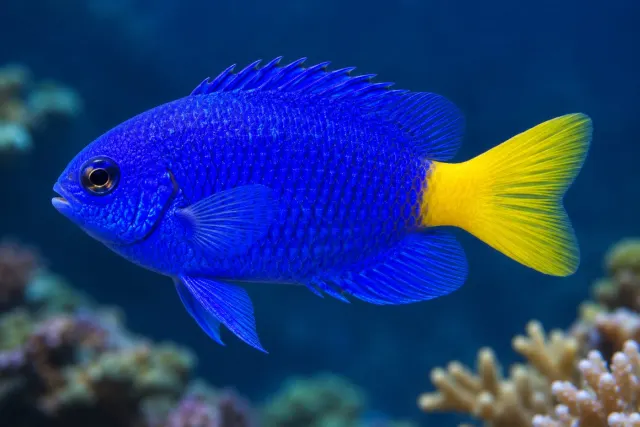
Damselfish · Pomacentridae
Care levelBeginner
Yellowtail Damselfish
Chrysiptera parasema
A vivid blue damselfish with a yellow tail. It is relatively manageable among damsels, but can defend rockwork and bully small or timid fish, especially around a nesting territory.
Hardy and generally easy to feed, but choosing suitable tank mates is essential.
Recommendation
Would you recommend this fish for a suitable saltwater aquarium?
30+ galRecommended tank
2.75 inchesAdult size
Semi-aggressive / territorialTemperament
Generally compatibleCoral safety
+ Why you’ll love them
- Bright blue-and-yellow coloration.
- Accepts varied appropriately sized marine foods.
- Generally compatible with corals and established invertebrates.
! Things to consider
- Can chase timid tank mates.
- Similar damsels may compete for territory.
- Small adult size does not remove the need for space and shelter.
Tank and habitat
- Recommended volume
- 30 US gallons or larger; allow for stocking and layout.
- Full-grown size
- 2.75 inches (maximum adult size)
- Tank footprint and swimming space
- Arrange separate rock territories and sight breaks. A tall open tank offers fewer usable refuges than a thoughtfully arranged footprint.
- Tank maturity
- Use a fully cycled, stable marine aquarium. Confirm filtration capacity before increasing the stock; elapsed months alone do not prove readiness. Suggested tank age is a planning guide, not proof of readiness. Complete cycling, stable water and the right food supply are essential.
- Habitat and equipment
- Provide secure rock crevices, circulation, filtration and a covered aquarium. Keep more than one escape route around shelters.
Care and compatibility
- Temperament
- Semi-aggressive / territorial
- Why this care level
- Hardy and generally easy to feed, but choosing suitable tank mates is essential.
- Suitable tank mates and conflicts
- Use compatible community fish that can withstand mild territorial behavior. Timid firefish and slow feeders need particular observation.
- Alone, pair or group
- One is the simpler plan. A group requires additional territories and careful observation; neither odd numbers nor extra gallons guarantee peace.
Corals and invertebrates
- Coral safety
-
Generally compatible
Generally compatible with corals; territory defense can still disturb nearby fish. - Shrimp safety
-
Generally compatible
Generally compatible with established ornamental shrimp; larvae may be eaten. - Snail safety
-
Generally compatible
Generally compatible with snails. - Clam safety
-
Generally compatible
Generally compatible with clams.
Food and feeding
- Diet
- Omnivore; varied marine foods
- Feeding plan
- Feed a varied omnivore diet in small portions. Check that territorial behavior does not block other fish from food.
- Prepared or live food
- Small marine pellets or flakes with appropriate frozen mysis, enriched brine shrimp and algae-containing preparations.
Water conditions
- Temperature
- 72–78 °F (22–26 °C). Keep temperature stable and check the shared range for all tank inhabitants.
- Specific gravity
- Specific gravity 1.020–1.025 is the published fish-care range. A reef aquarium must also meet the needs of its invertebrates.
- pH
- pH 8.1–8.4. Monitor alkalinity and maintain stability rather than making abrupt corrections.
Long-term care
- Lifespan
- A dependable typical captive lifespan is not established by the references used here. Plan for a long-term commitment.
- Growth and future planning
- Adults reach about 2.75 inches. Expect territory defense to become more noticeable with maturity or spawning.
Before you buy
- Is this fish right for your tank?
- Check the temperament of the existing stock and plan how to remove a territorial individual if necessary.
- Buying checklist
- Observe feeding, breathing and swimming before purchase. Check body condition, fins and eyes; arrange quarantine and confirm the seller’s identification.
User comments (0)